
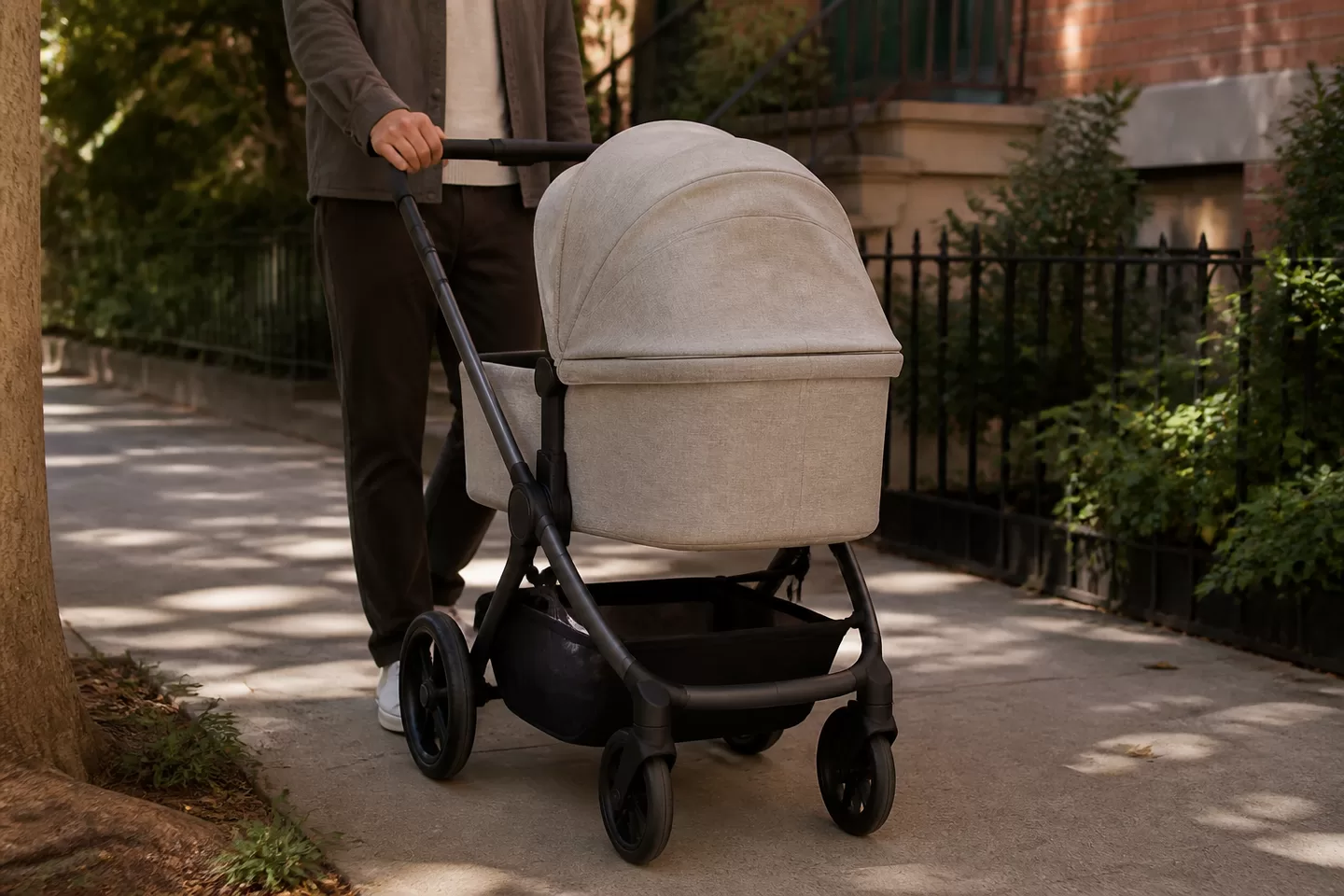


Map the route before comparing features
Write down the least glamorous trip you make often: apartment stairs, a narrow row-house hall, a bus entrance, a compact trunk, or a rough walk to daycare. Measure the tight point and the storage space. Stroller width, folded dimensions, and lift weight become much easier to judge when they have somewhere specific to fit.
Then separate daily needs from occasional ones. A large basket may matter every afternoon; a reversible seat may matter for a shorter season. If air travel happens twice a year, renting or borrowing a travel stroller can make more sense than accepting a compromised daily push for the other 363 days.
Wheel size changes the experience
Small wheels keep a stroller compact and nimble on smooth floors. Larger wheels and suspension handle broken pavement, gravel, grass, and curb cuts with less stopping and lifting. That extra capability usually brings more weight and a larger fold. There is no universal winner, only a better match for the surfaces outside your door.
A test push is useful even when the final purchase happens online. Turn in a tight aisle, cross a threshold, tip the front wheels over a curb, use the brake, and try the fold without a demonstration. If two adults will use it, both should adjust the handle and buckle the harness.
The newborn question belongs to the manufacturer
Do not assume a deep recline automatically makes a stroller suitable from birth. Use only the seat position, bassinet, or infant-car-seat attachment the manufacturer approves for your child's size and stage, with every required insert or adapter. Check the manual before buying accessories, especially across brands.
A stroller is transportation, not a general replacement for a crib, bassinet, or play yard. If a product is marketed for infant sleep, it falls under separate safety requirements. Follow the maker's instructions and move the baby to an appropriate sleep space when you are no longer traveling.
Small mechanics decide whether you enjoy it
A basket is only useful if you can reach it with the seat reclined. A one-hand fold is only useful if it locks closed and can be lifted in that position. Canopies should give practical coverage without blocking ventilation, and fabrics should clean without disassembling half the frame. These details are worth more than an extra accessory in the box.
Use the harness every ride and engage the parking brake whenever the stroller is stopped. Keep children clear of hinges while folding, and avoid hanging an overloaded bag from the handle. Register the stroller so the maker can contact you about recalls or safety updates.
The tradeoffs worth noticing
- Lightweight vs. forgiving ride
- Compact frames are easier on stairs and transit; larger wheels and suspension are calmer on uneven ground.
- Small fold vs. full-size comfort
- A shorter seat, shallower recline, smaller canopy, or tighter basket is often the price of an unusually compact fold.
- Modular system vs. simple ownership
- Bassinets, second seats, and car-seat adapters add flexibility, cost, storage, and more compatibility checks.
- Air-filled tires vs. low maintenance
- Air tires soften rough routes but can need pressure checks and repairs; foam or solid tires ask less upkeep.
What to skip
- Skip a stroller that cannot clear the home's narrowest doorway, fit the trunk, or be lifted by the adult who will use it most.
- Skip unapproved adapters and accessories that interfere with the harness, brake, fold, or stability.
- Skip a jogging model unless running is a real part of the plan. Follow that model's instructions for wheel position and when a child may ride while jogging.
- Skip the idea that one stroller must excel at newborn walks, flights, trails, shopping, and two children. Sometimes a focused daily stroller plus an occasional rental or later secondhand travel model is the more sensible system.
Common parent questions
- Do I need a stroller before the baby is born?
- Not always. Families who walk daily or need a defined way home may want one ready. Families who expect to use a carrier or car first can wait until their routines are clearer. Check lead times and return windows before deciding.
- Can a newborn ride in any fully reclining stroller?
- No. Use only a configuration the manufacturer explicitly approves for newborns or for your child's current size and stage. Follow its instructions for inserts, harness position, bassinets, car seats, and adapters.
- Is a travel system worth it?
- It can simplify short transfers and compatibility because the pieces are designed to connect. The tradeoff is often a heavier stroller and a system shaped around one infant car seat. Compare the stroller on its own merits, since it will likely be used much longer than the infant seat.
- What should I check on a used stroller?
- Identify the exact model and manufacture date, check current recalls, find the manual, and inspect the frame, wheels, brake, harness, latches, and folding joints. Pass if parts are missing, repairs are improvised, or its history and model cannot be established.