
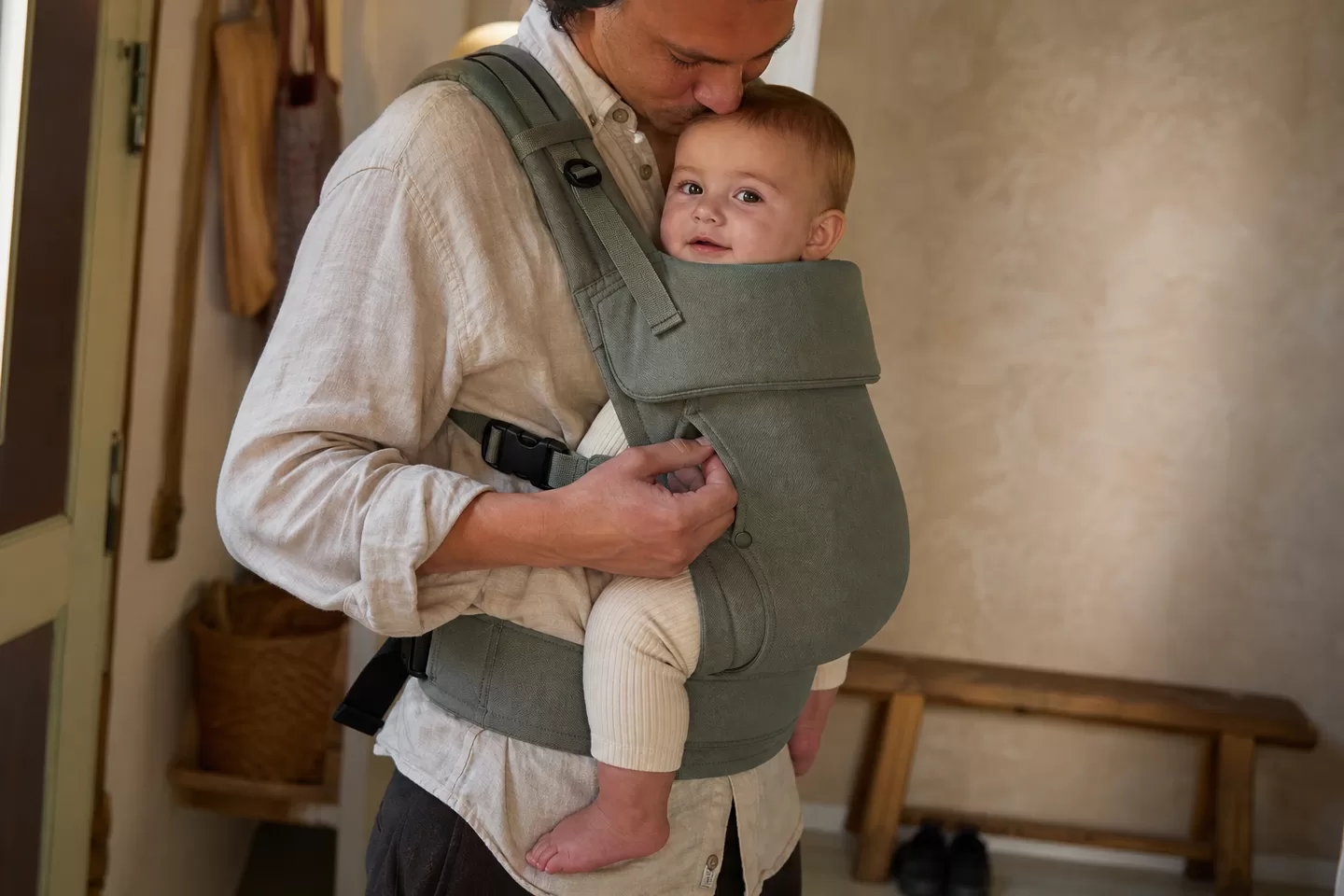


Choose a format you will use correctly
Stretchy wraps pack small and can fit many bodies, but they ask you to learn the tension and repeat the tie. Ring slings are fast for short carries and frequent up-and-down toddlers, but they load one shoulder and demand careful positioning. Buckled carriers are quicker to reproduce and often spread weight well, while taking more room in the closet and diaper bag.
None of those categories is automatically best. Be honest about patience, climate, hand mobility, and who will wear it. A carrier that feels intuitive is easier to use consistently than one whose clever conversion stays unexplored in the manual.
Fit the wearer, not the product photo
Start with the waistband or base positioned where the maker instructs, then tighten the carrier before judging the load. Shoulder straps should stay in place without cutting into the neck, and the child should not sag lower as you walk. If the carrier offers crossable straps, lumbar support, or multiple panel widths, treat those as fit tools rather than automatic upgrades.
Two adults may need genuinely different settings. Photograph or mark each person's repeatable setup if the straps are shared. Try ordinary motions such as walking, sitting, opening a door, and bending at the knees while keeping a hand on the child. Ten comfortable seconds in front of a mirror do not predict a forty-minute walk.
A clear airway is not a comfort preference
In any carrier, check the child often. The face should remain visible, the nose and mouth clear of fabric and the wearer's body, and the chin away from the chest. Follow the carrier's manual exactly, especially for young infants and after feeding.
CPSC warns that babies younger than four months and babies born prematurely, at low birth weight, or with respiratory concerns need extra caution in sling-style carriers. Ask the child's clinician for individual guidance when those circumstances apply. A carrier should never make it hard to see or monitor the baby.
Let positions follow the manual and the child
Front inward, front outward, hip, and back carries have different requirements. Use only positions the specific carrier supports, and wait until the child meets its stated developmental and size criteria. An age printed in a roundup is not a substitute for the manufacturer's instructions.
As the child grows, reassess panel width, seat height, leg openings, and strap tension. The setup that worked with a small infant can become uncomfortable months later. A good carrier may adapt; it does not adapt by itself.
The tradeoffs worth noticing
- Wrap vs. buckles
- Wraps are compact and highly adjustable; buckled carriers are faster to repeat and usually simpler to share after each wearer learns their settings.
- Soft structure vs. firm support
- Less structured carriers mold closely and pack down; more structure can distribute load but may feel bulky or hot.
- One carrier for everyone vs. individual fit
- A wide adjustment range helps, but two very different wearers may be happier with separate carriers than constant rethreading.
- Breathable mesh vs. soft natural fabric
- Mesh may feel cooler and dry faster; softer woven fabrics can feel less technical against skin. Neither cancels the need to monitor temperature and fit.
What to skip
- Skip any carrier whose maker, model, size range, instructions, or required insert cannot be identified.
- Skip a carrier if the child's face disappears into fabric or the fit pushes the chin toward the chest.
- Skip unsupported carry positions, improvised knots, and cross-brand add-ons that are not approved for that model.
- Skip the promise that babywearing is truly hands-off. Watch the child, keep a hand available when bending or moving through hazards, and use the restraints exactly as directed.
Common parent questions
- Can I use a baby carrier from birth?
- Some models allow newborn use and others do not. Check the minimum size, required insert or panel setting, approved carry position, and fit instructions. For a baby born prematurely, at low birth weight, or with respiratory concerns, ask the child's clinician before using a sling or carrier.
- How can I tell whether the baby's position is safe?
- Follow the model's manual and check frequently that the face is visible, the nose and mouth are clear, the chin is not pressed to the chest, the fasteners are secure, and the child cannot slip through the leg openings. Stop and reposition if you cannot maintain that view and fit.
- When can I use a back carry?
- Only when the carrier's instructions allow it and the child meets every stated developmental and size requirement. Practice the transfer with another adult over a soft, clear area before attempting it alone.
- Do I need more than one carrier?
- No. One that fits the main wearer, current child, and usual outings can be enough. A second style becomes useful only when it solves a specific difference, such as another wearer, a faster toddler carry, or a hot-weather route.